


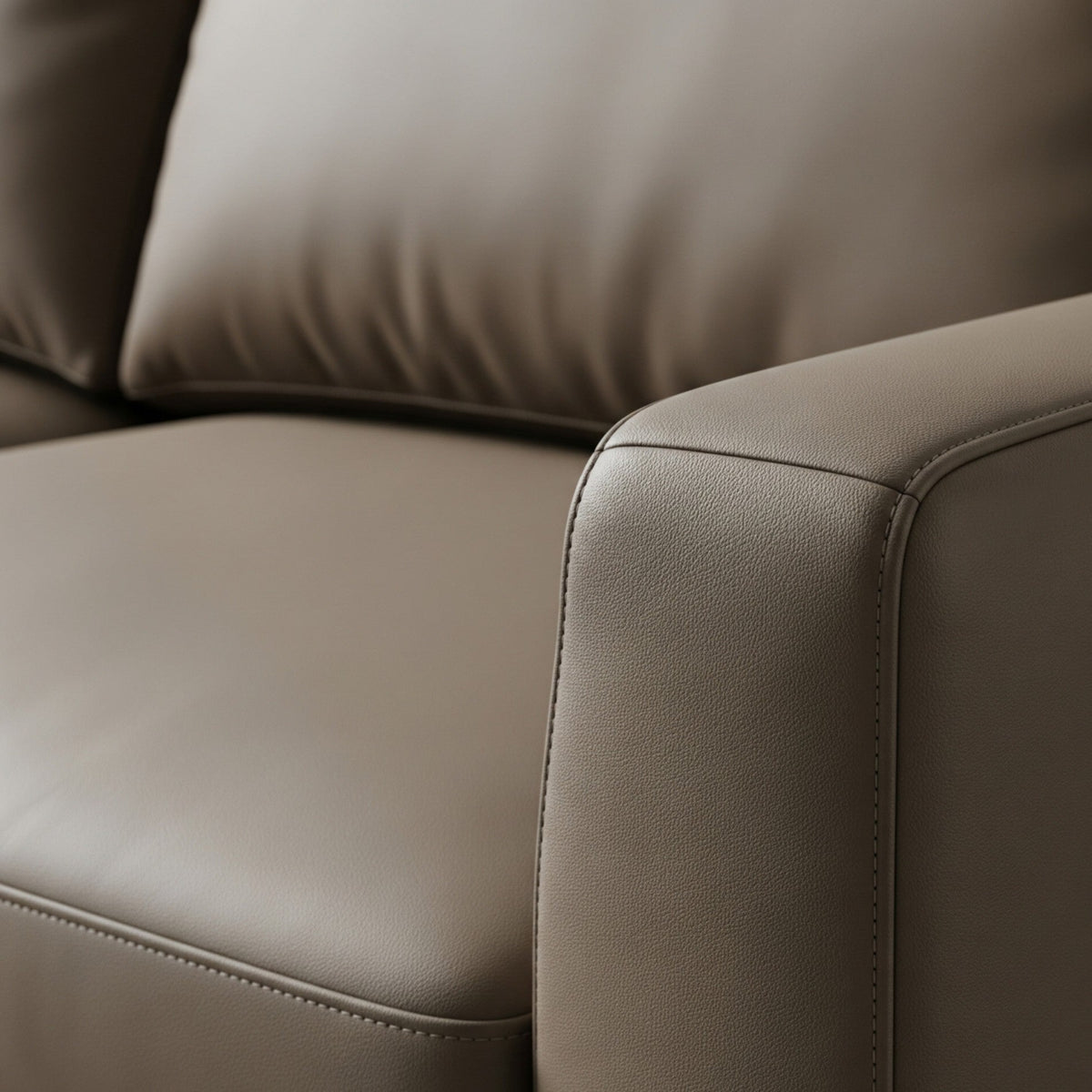
Genuine leather or faux leather: differences, durability, and true cost
Material Comparison
Genuine leather or faux leather: differences, durability, and real cost
When newly upholstered, they look similar. The difference becomes apparent after three years, after seven, after fifteen.
In a store, a genuine leather sofa and a faux leather one might look similar. That's where the two materials take divergent paths.
This comparison is frank and includes cases where faux leather is the most sensible choice.
Two materials that only look similar at first
In a store, when newly upholstered, a genuine leather sofa and a faux leather one might look similar. The difference becomes apparent later: after three years, after seven, after fifteen. That's where the two materials take divergent paths.
This article provides a frank comparison of the two options, including cases where faux leather is the most sensible choice.
What they are, exactly
Pay attention to the name
"Eco" refers to the appearance, not an automatic environmental benefit. Faux leather is a textile backing coated with polyurethane or PVC, hence a petroleum derivative.
Genuine leather is a material of animal origin, a byproduct of the food industry, transformed through tanning into a stable and durable material. It has a fibrous structure, breathes, and absorbs.
Faux leather is a synthetic material: a textile backing coated with a layer of polyurethane or PVC, then embossed to mimic the grain of leather. The name is commercial and can be misleading: "eco" refers to the appearance, not an automatic environmental benefit.
How to recognize them in thirty seconds

- The cut edge. This is the most reliable test. Genuine leather shows a fibrous and irregular cross-section; faux leather shows two distinct layers: the film and the fabric underneath.
- The grain. On genuine leather, the pattern never repeats identically. On faux leather, being embossed from a mold, the design repeats at regular intervals: just observe a large surface to notice this.
- The warmth. Genuine leather absorbs body heat and becomes warm. Faux leather remains cold longer and tends to feel slippery.
- The smell. Unmistakable on genuine leather, practically absent or vaguely plastic on faux leather.
How they behave over time

This is the central point of the comparison.
Genuine leather ages: it develops a patina, the color softens, and the material conforms to the shape of its user. A fifteen-year-old leather sofa doesn't look new, but it rarely looks ruined.
Faux leather degrades: the surface layer, which is an applied film, tends to stiffen, crack, and finally peel over the years, typically on armrests and cushion edges. When this happens, it's not repairable, because there's no underlying material to recover: there's only the fabric backing.
The speed of the process depends heavily on product quality and exposure to heat and light, but the general direction is always the same.
The true cost, really examined
The right question is: how many years should this piece last?
Beyond five years, the economic comparison almost always reverses.
Faux leather costs less to purchase, that's a fact. However, the sensible reasoning is different: how much does it cost per year of use.
A synthetic upholstery that needs to be replaced after a few years, considering the cost of the material plus the labor to redo the work, can end up being more expensive than genuine leather that lasts decades and, at most, can be restored instead of replaced.
The calculation changes if the item is intended for a short lifespan by choice: a temporary setup, furniture meant to be changed for aesthetic reasons within a few years, or a situation of very heavy use where replacement is anticipated.
Comparison table
| Genuine Leather | Faux Leather | |
|---|---|---|
| Initial Cost | Higher | Lower |
| Durability | Decades | Several years |
| Aging | Patina | Cracking |
| Breathability | Yes | No |
| Repairability | Good | Very limited |
| Uniformity | Variable | Total |
| Maintenance | Periodic | Minimal |
How to assess quality when buying
A sign that applies to both
The lack of technical data is an information in itself. Thickness in millimeters for leather, Martindale cycles for synthetics: if they can't tell you, ask yourself why.
Within the same category, the differences are enormous, and this applies to both materials.
For genuine leather, the concrete indicators are thickness — which must be declared in millimeters, not described in words — the uniformity of the tanning, the hand-feel, and the seller's transparency regarding origin and type of finish. A salesperson who can tell you whether a leather is pigmented, full-grain or nubuck, and its thickness, is giving you verifiable information.
For faux leather, what matters is the thickness of the coating layer, the type of textile backing, and the abrasion resistance data, usually expressed in Martindale cycles. High-end faux leather with a solid backing lasts much longer than an inexpensive one, and the difference between the two is greater than the common name suggests.
In both cases, the lack of technical data is information in itself.
The environmental question, without slogans
This is the point where most inaccuracies are stated, from both sides.
Genuine leather is a byproduct of the food industry: these hides exist anyway, and tanning transforms them into a durable material instead of waste. Tanning has a real impact, which modern processes have greatly reduced compared to the past, and it is a material of biological origin.
Faux leather is a petroleum derivative applied to a textile backing. It does not require animal farming, but it is not biodegradable and, at the end of its life, it is difficult to recycle because it is a combination of different materials.
Then there's the factor that weighs most heavily and that almost no one accounts for: durability. A material that lasts twenty years has a much lower annual impact than one that needs to be replaced three times in the same period, each time counting production, transport, labor, and disposal of the old item.
What about scraps?

A third option worth knowing about, especially for small projects.
Leather processing inevitably produces scraps: perfectly intact pieces leftover from cutting patterns on the hide. They are genuine leather in all respects, with the same tanning and quality, just in unpredictable sizes.
For leather goods, crafts, small repairs, upholstery of single seats, or prototypes, they are the most sensible solution in every aspect: they cost much less than material by the meter, and they use what would otherwise become waste. The only limit is that you cannot rely on a precise format, so they are not suitable for a project requiring large and continuous pieces.
When faux leather makes sense
To be fair, it must be said, because there are real cases:
- When absolute uniformity is needed across many identical pieces, for example in a commercial setup.
- When the initial budget is the main and non-negotiable constraint.
- When the item has a short expected lifespan due to its intended use.
- For a personal ethical choice not to use animal-derived materials, while keeping in mind that synthetics have their own environmental impact.
When genuine leather is the right choice
When the item needs to last, when it has sentimental or representative value, when use is daily and intensive, and whenever the cost should be spread over a long horizon rather than just the moment of purchase.
A less measurable aspect also applies: leather upholstery can be restored, re-dyed, and refurbished. A well-executed project, with the right material, endures.
In summary
There is no single answer for everyone, but there is a right question to ask: how many years should this item last? If the answer is more than five years, the economic comparison almost always turns in favor of genuine leather.
Want to evaluate the material in your hands? Request samples of the leathers you are interested in and compare them directly: the difference can be recognized by touch in a few seconds.
Want to evaluate the material in your hands?
Request samples of the leathers you are interested in and compare them directly: the difference can be recognized by touch in a few seconds.
Request samples
Leave a comment
This site is protected by hCaptcha and the hCaptcha Privacy Policy and Terms of Service apply.