

Article: How much leather is needed to upholster a sofa

How much leather is needed to upholster a sofa
PellTex Practical Guide
How much leather do you need to reupholster a sofa?
Ordering too little stops the work halfway. Ordering too much means immobilized budget.
Before ordering leather for a sofa, the question is always the same: how much do you actually need? This step is often estimated by eye, and it's also the one that causes the most problems.
In this guide, you'll find a method you can apply in five minutes, a table by sofa type, and the most common mistakes we see.
The question that blocks every estimate
Before ordering leather for a sofa, the question is always the same: how much do you actually need? Ordering too little means stopping the work halfway and risking a second batch with a slightly different shade. Ordering too much means paying for material that remains in the warehouse.
In this guide, you'll find a method you can apply in five minutes, without software or upholstery experience.
Why leather is not calculated like fabric

The areas of a hide: butt, neck, and flanks do not yield the same amount.
Fabric comes in rolls of constant width: it's measured in linear meters, and the yield is predictable. Leather is not. A hide is an animal's skin, so it has an irregular shape, with the neck, butt, and flanks yielding differently.
Two practical consequences:
- The nominal surface area is not entirely usable. The edges follow the animal's profile and do not provide rectangular pieces.
- The zones are not equivalent. The butt is the most compact and uniform part, ideal for seat cushions; the flanks are more flexible and better used for less stressed parts.
This is why a higher margin is used for leather compared to fabric.
The three-step method
Net surface area × 1.3 = square meters to order
The 30% margin covers waste, tuck-ins, and seams.
1. Measure the net surface area
Break down the sofa into simple surfaces and measure them one by one: backrest, right armrest, left armrest, seat cushions (front and back), back cushions, front panel, outer flanks.
For each piece, multiply height by width in meters and sum everything. The result is your net surface area in square meters.
2. Add the margin
For leather, the recommended safety margin is approximately 30%. This covers cutting waste, tuck-ins under the frame, seams, and the unusable part of the hide.
The formula is simple:
Net surface area × 1.3 = square meters to order
3. Check the number of hides
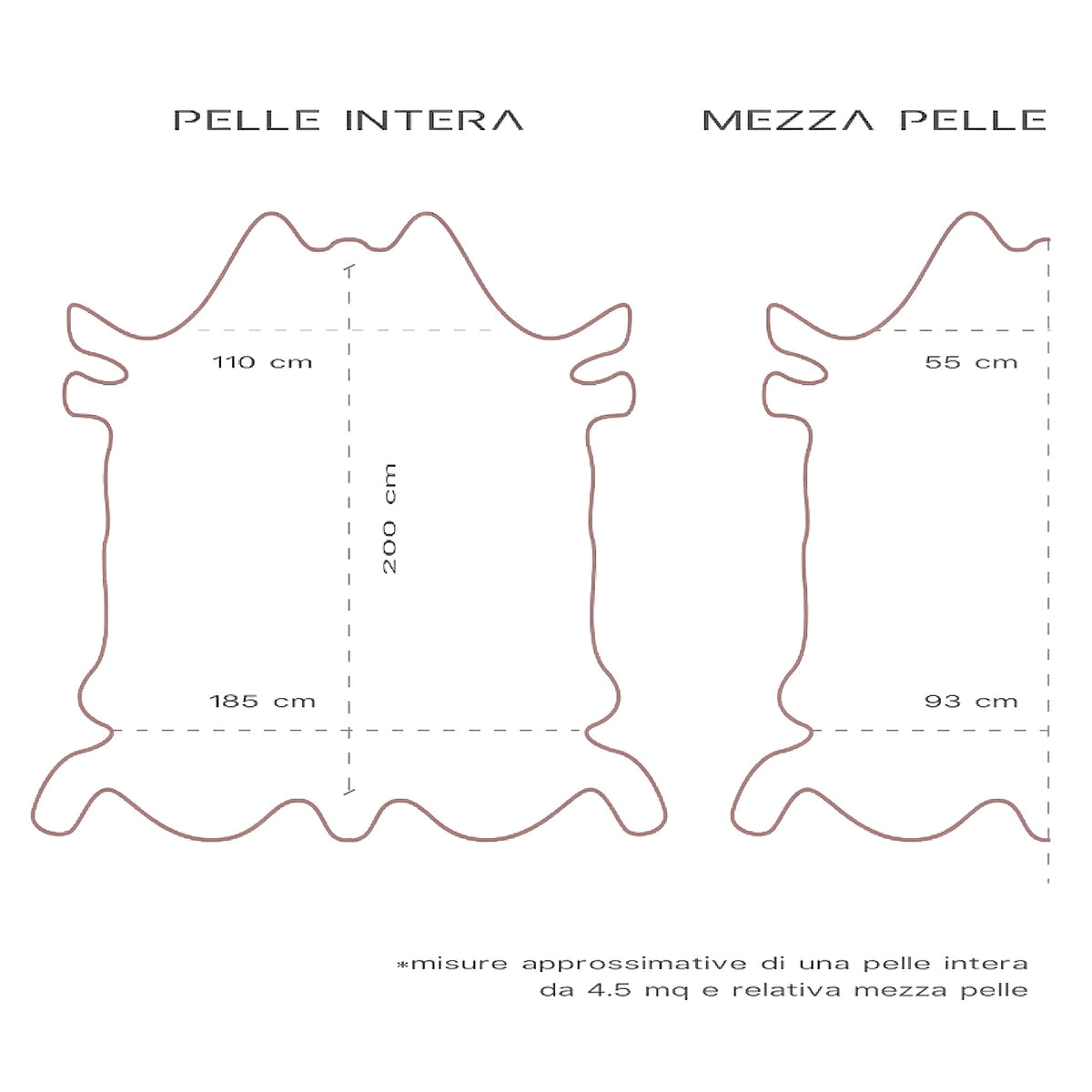
A bovine hide averages between 4.5 and 5.5 square meters. Dividing your requirement by this value gives you how many hides you need, and it's always best to round up: buying half a hide is not possible.
Practical table by sofa type

Indicative values, already including the 30% margin. These are for guidance before measuring, they do not replace actual measurement.
| Type | Net surface area | To order |
|---|---|---|
| Single armchair | 3 - 4 m² | 4 - 5 m² |
| 2-seater sofa | 7 - 9 m² | 9 - 12 m² |
| 3-seater sofa | 10 - 13 m² | 13 - 17 m² |
| Corner sofa | 16 - 20 m² | 21 - 26 m² |
Variables that push the result upwards are the thickness of the padding, the presence of reversible cushions, and enveloping armrests.
Four mistakes to avoid
- Measuring the old sofa instead of the new one. If you're replacing upholstery, the padding may have been compressed by use: renewed, it will occupy more surface area.
- Forgetting the tuck-ins. Each flap that goes under the frame is several centimeters per side, and they add up.
- Ordering at two different times. Hides from different batches can have a slightly different color rendition. Better one extra hide now than an addition later.
- Ignoring the material's direction. On pull-up leathers or those with irregular surfaces, the cutting direction affects the visual result: they must all be oriented the same way, and this consumes more.
How to clear your doubts before ordering

If the project is important, two precautions reduce the risk almost to zero. The first is to request a physical sample of the chosen color: screen rendition is always indicative. The second is to have the calculation confirmed by the material supplier, communicating the measurements and type of sofa.
At PellTex, leather is purchased with custom cutting, so you can order exactly the square meters you need without the constraint of a whole hide.
How much a hide actually yields
Good to know
A bovine hide averages between 4.5 and 5.5 square meters, but its irregular shape means that the actually usable surface is always less than the nominal data.
The data missing from almost all hurried estimates is the actual yield. A hide declared 5 square meters does not produce 5 square meters of usable pieces, because its shape is not rectangular and because not all areas have the same characteristics.
The three main zones behave as follows:
- Butt. This is the central part of the back, the most compact, uniform, and stable. It works very well for large, stressed pieces: seat cushions, backrests, front panels.
- Neck. It presents the animal's natural folds. These are part of the leather's character, but on a large, visible surface, they can appear irregular. Excellent for medium-sized pieces and parts where the fold is not an issue.
- Flanks. More flexible and elastic, with some irregularities on the edge. They are very suitable for non-stressed parts, tuck-ins, and small pieces.
Hence the practical rule: if your project requires many large and uniform pieces, the actual yield will be lower, and it's advisable to stay at the higher end of the margin. If, on the other hand, the work consists of small pieces, you can also utilize the edge areas, and the yield increases.
Custom cut or whole hide?
These are two different ways of purchasing, and the choice changes depending on the project.
Custom cutting gives you exactly the square meters you request. It's the right choice when you know the requirement, when there's only one project, and when you don't want to tie up material in stock. It's also the most cautious option for those approaching a product they are unfamiliar with for the first time.
A whole hide is convenient when you work continuously on the same item, as it allows you to choose which area to cut each piece from and optimize placement. This is the method for those with an equipped workshop and who produce regularly.
If you have doubts about the requirement, custom cutting reduces the risk: you can start with the calculated quantity and supplement it later, keeping in mind the note on batches below.
The specific case of reupholstering
Practical tip
Disassemble the old upholstery and use it as a template: it's much more accurate than measuring the assembled sofa. However, remember to add the seam allowance, which is already consumed in the disassembled piece.
Upholstering a new sofa and reupholstering an existing sofa are not the same job, and the calculation changes.
For reupholstery, you must consider that the original padding, if used for years, has compressed. If you restore or replace it—which is almost always advisable when reupholstering—the volume returns to its factory state, and the surface to be covered increases compared to what you measure today on the worn piece.
The second aspect is using the old upholstery as a pattern. Carefully disassembling it and using it as a template is the most reliable method for obtaining measurements, much more precise than measuring the assembled sofa. With one caveat: add the seam allowance to the pieces, which is already consumed in the disassembled upholstery.
In summary
Measure the surfaces one by one, sum them, multiply by 1.3, and round up. It's only seemingly a rough method: in workshop practice, it's what prevents 90% of purchasing errors.
Are you choosing leather for your project? Browse the available families and request a sample of the color you're interested in before ordering.
Are you choosing leather for your project?
Browse the available families and request a sample of the color you're interested in before ordering.
Discover PellTex leathers
Leave a comment
This site is protected by hCaptcha and the hCaptcha Privacy Policy and Terms of Service apply.