


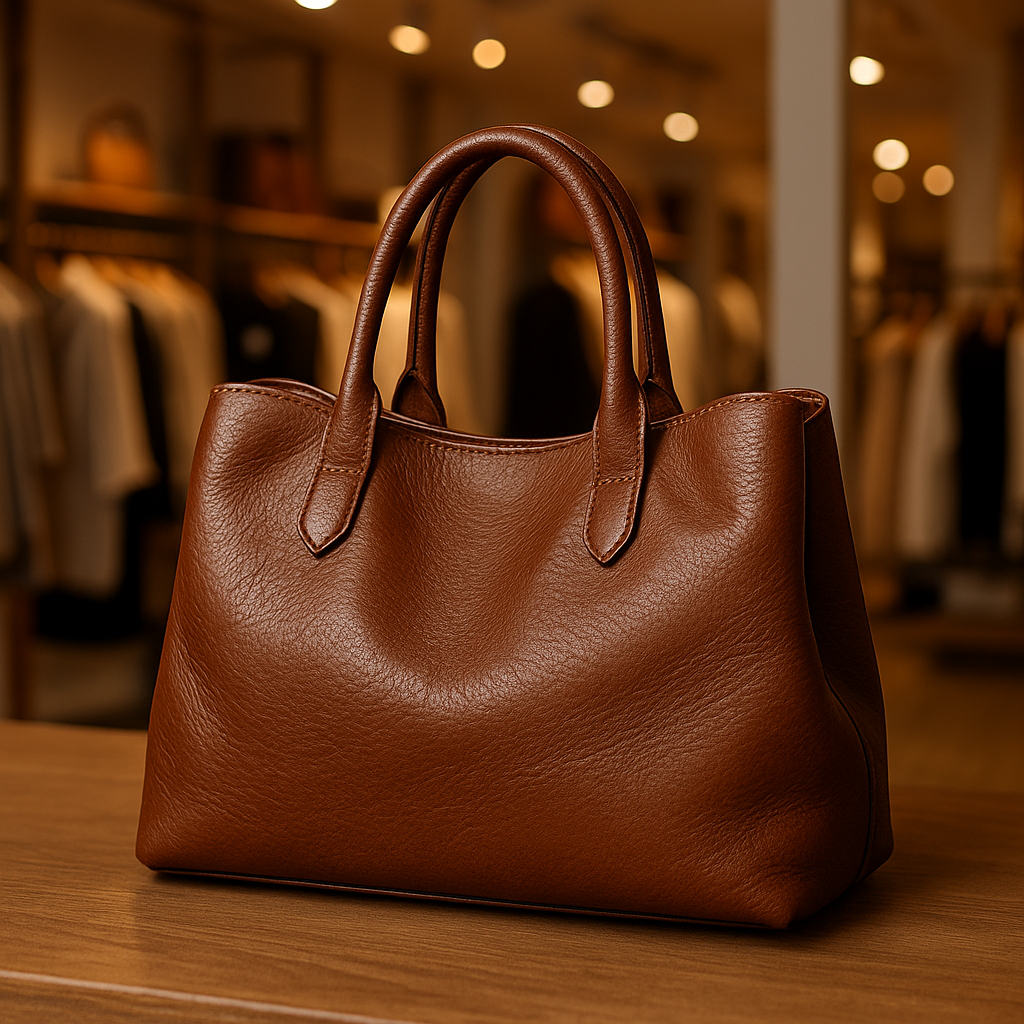
Pigmented, full-grain, nubuck, or waxed leather: how to identify them
Understanding materials
Pigmented, top-grain, nubuck or waxed leather: how to identify them
Two hides of the same animal can behave in opposite ways. The difference is not quality: it's the finish.
One resists scratches and can be cleaned with a cloth, the other absorbs a drop of water in a few seconds. Understanding which finish you're looking at is the quickest way to know if a leather is suitable for your project.
Here you'll find the four main finishes, how to recognize them by touch, and how they behave over time.
Same raw material, very different results
In brief
The finish is the treatment applied to the surface of the leather. It determines durability, maintenance, and appearance over time much more than the origin of the hide.
Two leathers can come from the same type of hide and behave in completely different ways: one resists scratches and can be cleaned with a cloth, the other absorbs a drop of water in a few seconds. The difference is not quality: it's the finish, i.e., the treatment applied to the surface.
Understanding which finish you're looking at is the quickest way to know if a leather is suitable for your project.
Pigmented leather
This is the most common finish in furniture. A layer of pigment is applied to the surface to unify the color and protect the underlying grain.
How to recognize it: very uniform color, slightly more "closed" surface to the touch, a drop of water remains on the surface without penetrating.
Strengths: it is the most resistant to daily use, the easiest to clean, and the most consistent from one hide to another. If you need to cover multiple pieces that will be close to each other, pigmented leather ensures the best uniformity.
Limitations: precisely because the color is opaque, the natural grain of the leather is less visible.
In the PellTex catalog, this includes items like Spessorato, with a hammered dollar print and a thickness of 1.3-1.5 mm, and Pamplona, with high thickness and a marked print.
Top-grain leather

The "grain" is the outermost and most valuable layer of the hide, which carries the animal's original texture. In top-grain leathers, this layer is maintained and enhanced rather than covered.
How to recognize it: the grain is never perfectly repetitive; looking closely, you can notice micro-variations that a print would not reproduce.
Strengths: soft hand, authentic look, superior breathability. It's the choice for those who want it to be evident that it is genuine leather.
Limitations: being less protected, it requires a little more attention to marks and stains.
In the catalog, this includes Natural, soft and enveloping, and Stone, where the irregular surface brings different color variations to each leather.
Nubuck
Nubuck is obtained by lightly sanding the grain side until a velvety surface is achieved. It should not be confused with suede, which is made from the inner side.
How to recognize it: by running your hand over it, you can see the nap change direction and tone, just like on velvet.
Strengths: warm and inviting touch, very elegant matte effect, deep color rendering.
Limitations: it is the most delicate finish towards liquids and grease. It works well on armchairs, headboards, and accent pieces; on a sofa used daily by a large family, it requires more care.
In the catalog, this includes Maya, a suede nubuck with a velvety touch.
Waxed leather and pull-up effect
Here, the leather is treated with waxes and oils that migrate when the material is stretched or bent. The result is that in areas of tension, the color lightens, creating a lived-in effect that changes over time.
How to recognize it: bend a flap between your fingers. If a lightening appears and then disappears when you release it, it's a pull-up effect.
Strengths: strong character, appearance that improves with use, each piece becomes unique.
Limitations: it is not the right choice if you are looking for a perfectly uniform and stable color over time.
In the catalog, this includes Etrusco, a waxed leather with timeless charm, and the Pull-Up family.
What about structural leather?
How to distinguish it immediately
If the material needs to support a structure instead of following it, you need structural leather. If it needs to wrap an existing shape, you need upholstery leather.
Structural leather is a separate category: it is not designed for upholstery, but to stand on its own. It has a rigidity that allows it to maintain its shape, and is therefore used for unsupported seating, technical bags, belts, and accessories.
If your project requires the material to support a structure rather than follow it, structural leather is the answer.
Quick comparison table

| Finish | Resistance | Maintenance | Ideal Use |
|---|---|---|---|
| Pigmented | High | Minimal | Heavy-use sofas, contract |
| Top-grain | Medium | Moderate | Residential furniture, craftsmanship |
| Nubuck | Medium-low | Careful | Armchairs, headboards, accent pieces |
| Waxed / pull-up | High | Moderate | Furniture with a lived-in character |
| Structural leather | Very High | Minimal | Self-supporting seats, leather goods |
How to test leather in five minutes

If you have a sample in hand and want to understand its finish, four quick tests will almost always give you the answer.
The drop test
Place a drop of water on the surface and wait thirty seconds. If it remains beaded on the surface, you have a pigmented leather with good protection. If it darkens slowly and is absorbed, you have a top-grain leather or nubuck. Dry it immediately in any case.
The fold test
Fold the sample over itself and observe the tension area. If the color lightens and then returns, it's a pull-up effect. If dense and regular micro-folds appear, it's a printed surface. If the fold is soft and leaves no mark, the leather has a good feel.
The fingernail test
Lightly run your fingernail over it. On nubuck, a clear mark remains that can be removed by stroking it in the opposite direction: this is characteristic of sanded nap. On pigmented leather, nothing remains.
The glancing light test
Tilt the sample towards a light source and look at it from an angle. Natural grain shows continuous and never identical variations. A print shows a repeating pattern at regular intervals: once you notice it, you can't unsee it.
How each finish behaves over time
The choice of finish not only determines the initial appearance but also how the piece will look ten years from now.
A pigmented leather maintains its original appearance for a very long time: this is its merit and, for some, its limitation. It does not develop a patina; it essentially remains as it was on the first day until the finish begins to show wear in areas of maximum friction.
A top-grain leather changes: the color softens, the surface acquires a sheen where it is touched most often, and the hand becomes softer. This is the aging many seek.
Nubuck tends to polish in contact areas, losing its velvety effect precisely where the piece is used most. On an armchair, this is often pleasant; on an everyday sofa armrest, it can appear uneven.
Waxed and pull-up leathers are those that change the most, and intentionally so: the lightenings stabilize, the shades layer, and after a few years, the piece tells the story of how it has been used.
Three common misunderstandings
- "Full-grain leather" and "top-grain leather" are not the same thing. The term indicates the layer used, not automatically the absence of finish: there are full-grain leathers that are also pigmented.
- Nubuck is not suede. Nubuck is obtained by sanding the outer side, while suede is made by working the inner side. They are similar to the touch, but resistance and color rendering are different.
- A very uniform grain does not mean superior quality. Often it means the opposite: perfect regularity is typical of printed surfaces, while natural leather is by definition irregular.
How to choose without making a mistake
Start with the use, not the aesthetics. If the piece will be used daily, by children or pets, pigmented leather will give you the longest life without worries. If, on the other hand, you are creating a piece that needs character and will be cared for, top-grain, nubuck, and waxed leathers offer a result that pigmented leather cannot.
Not sure what you're touching? Request samples of the finishes that interest you: five minutes with the material in hand are worth more than any description.
Not sure what you're touching?
Request samples of the finishes that interest you: five minutes with the material in hand are worth more than any description.
Request samples
Leave a comment
This site is protected by hCaptcha and the hCaptcha Privacy Policy and Terms of Service apply.