


How to clean real leather without ruining it
Care and maintenance
Most damage doesn't come from lack of cleaning, but from using the wrong product with the best intentions.
An aggressive degreaser or an overly wet cloth can cause damage in an afternoon that normal use would take ten years to inflict.
Here you'll find what to do, how often, and what never to do, with differences between various finishes.
Leather is damaged more by over-care than neglect
Most of the damage we see on leather upholstery doesn't come from a lack of cleaning, but from using the wrong product with the best intentions. An aggressive degreaser or an overly wet cloth can cause damage in an afternoon that normal use would take ten years to inflict.
This guide explains what to do, how often, and most importantly, what never to do.
The ordinary routine

Every week
Wipe with a dry microfiber cloth or vacuum with a soft brush, paying attention to creases and seams. Dust that settles in creases acts as an abrasive every time you sit down: removing it is the most effective maintenance action, and it costs nothing.
Every one or two months
Light cleaning with a slightly damp microfiber cloth, never wet, and a pH-neutral leather-specific cleaner. Work in small areas, and dry immediately with a second clean cloth.
Once or twice a year
Apply a nourishing or protective product. Leather is a natural fiber: over time, it loses the oils that keep it elastic, and without replenishment, it tends to stiffen and crack in flex points.
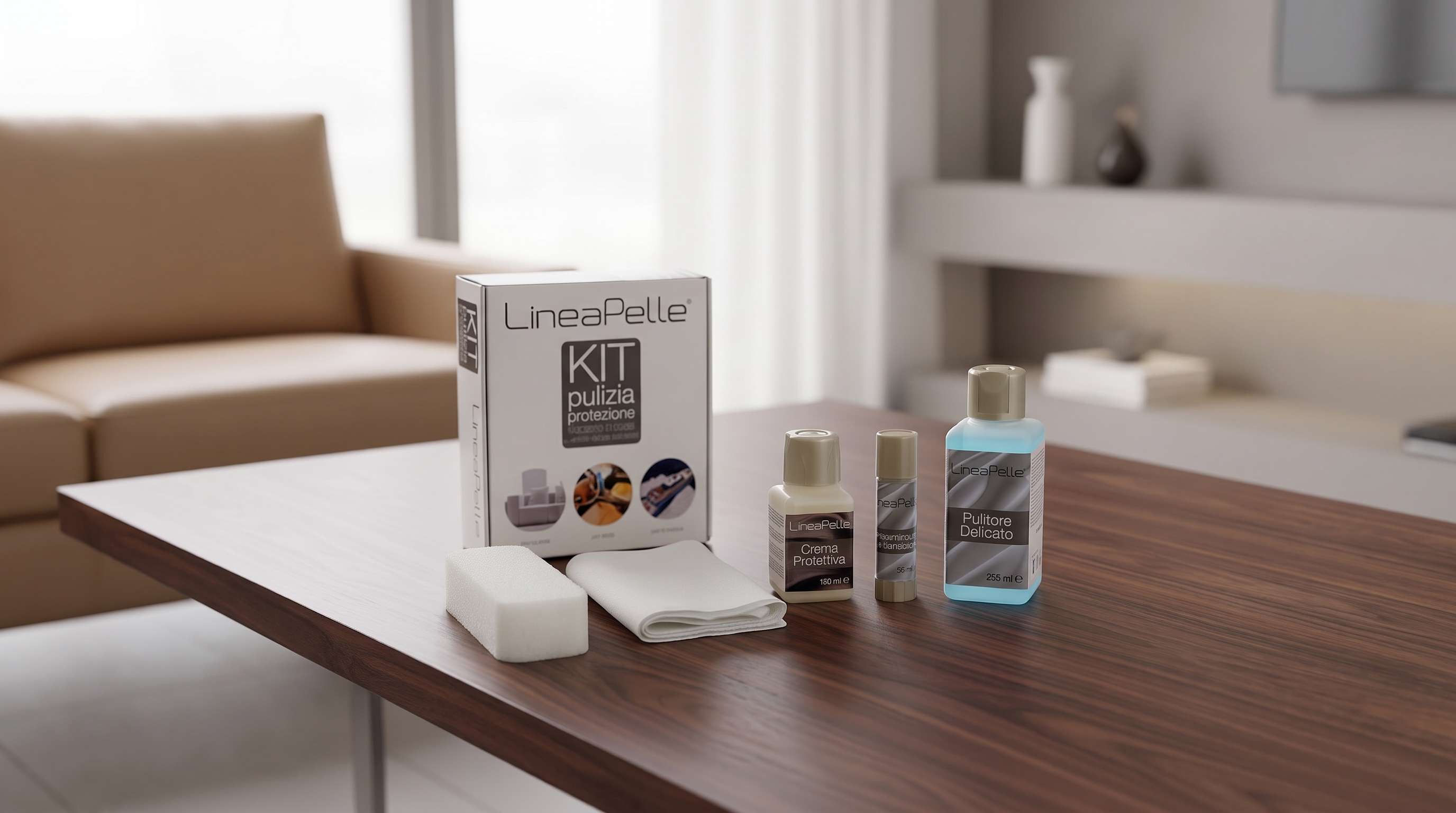
This is exactly the role of rejuvenating kits that combine cleaning, nourishment, and protection in a single cycle.
What never to use
- This list applies to all types of leather, without exception:
- Alcohol and solvents. They dissolve the finish and leave permanent dull stains.
- Ammonia and bleach. They attack the color and dehydrate the fiber.
- Dish soap or laundry detergent. They are alkaline: they alter the pH of the leather and dry it out over time.
- Abrasive sponges and rough cloths. They mark the surface irreversibly.
- Steam. Moist heat opens the fiber and can deform the upholstery.
- Furniture wax and silicone products. They create a film that prevents the leather from breathing.
The rule that saves your work
Always test in an inconspicuous area, and wait for it to dry
Thirty minutes of patience can prevent irreparable damage.
Whatever product you are about to use, even if it is specifically for leather, test it first in an inconspicuous area: the back of an armrest, the underside of a cushion, the side against the wall.
Apply, wait for it to dry completely, and only then evaluate. Thirty minutes of patience can prevent irreparable damage.
The most common stains
Liquids
Blot immediately, without rubbing. Rubbing spreads the stain and pushes it deeper. Absorb with a dry cloth, pressing from the outside towards the center.
Grease and oil
Do not use water: it will make it worse. Sprinkle the area with an absorbent powder, let it sit for a few hours, and gently remove. If a trace remains, use a specific cleaner.
Ink
This is the most difficult case and where DIY causes the most damage. For a large ink stain on valuable leather, it's better to consult a restorer than to try to fix it yourself.
Beware of delicate finishes
Not all leathers react in the same way.
Pigmented leathers have a protective surface layer and tolerate ordinary cleaning well. Full-grain leathers and those with a natural surface are more absorbent and should be treated with less water and more delicacy.
Nubuck deserves a separate mention: it has a velvety surface that water flattens and stains easily. It should be dry cleaned with a dedicated soft brush, and never with damp cloths.
On waxed pull-up leathers, tone variations are part of the material's aesthetic: they should not be interpreted as stains or corrected.
A different routine for each type of piece

Maintenance frequency depends not only on the material, but on how much and how the piece is used.
Living room sofa, daily use
This is the most demanding case. Weekly dusting, light cleaning every month, nourishment twice a year. If there are pets in the house, add a pass with a soft brush to remove hairs that get into the seams.
Armchair or accent piece
Reduced use, so a lighter routine: dusting every two weeks, cleaning every two or three months, nourishment once a year. The main risk here is not wear but light: accent pieces are often near a window.
Headboards and wall panels
These are the pieces most easily forgotten. They receive little contact but accumulate dust, and in the case of headboards, they come into contact with hair and personal care products, which are greasy. Light cleaning every two months is sufficient.
Chair and stool seats
Small surface but very high and concentrated stress. Here, periodic nourishment matters more than elsewhere, because the leather always works in the same flexion points.
How to apply a nourishing product
The right order
Cleaning, complete drying, then nourishment. Applying a nourishing product to dirty leather fixes the dirt within the fibers.
The application method matters as much as the product chosen.
Work in small areas, about half a square meter at a time, so you can check the result before proceeding. Apply a minimal amount to a microfiber cloth, never directly onto the leather: pouring the product onto the surface creates streaks that are difficult to even out.
Distribute with light circular motions, without pressing. Then let it absorb for the indicated time—usually a few minutes—and remove any excess with a second clean, dry cloth. The final step is not optional: excess product left on the surface becomes a sticky film that attracts dust.
Never apply to dirty leather: the nourishing product would fix the dirt within the fibers. The correct sequence is always cleaning, complete drying, then nourishment.
When to call a professional

There are situations where DIY causes more damage than the problem it aims to solve.
- Ink, dye, or solvent stains on large surfaces or light-colored leather.
- Cracks already present: these should be treated before they become tears, and require reconstruction products.
- Sun fading over an extended area: this requires partial re-dyeing, which is a technical job.
- Tears and cuts. The sooner you intervene, the better: a clean, sharp cut repairs much better than one frayed by use.
Professional restoration costs a fraction of new upholstery, and for a valuable piece, it is almost always the most sensible choice.
Prevention is better than cleaning
Three tips that truly extend the life of upholstery:
- Keep it away from direct sunlight. This is the factor that causes discoloration more than any other, and it acts slowly but irreversibly.
- Distance from heat sources. Radiators and stoves dry out the fiber and make it brittle.
- Rotate cushions. This distributes wear instead of concentrating it on the preferred spot in the house.
In summary
Dust often, clean sparingly and gently, nourish once or twice a year, and always test in an inconspicuous area. Leather treated this way maintains its appearance for decades, and over time develops a patina that no synthetic material can imitate.
Need the right product? The professional rejuvenating kit covers cleaning, protection, and care in a single cycle, and is suitable for furniture, cars, boats, and leather goods.
Need the right product?
The professional rejuvenating kit covers cleaning, protection, and care in a single cycle, and is suitable for furniture, cars, boats, and leather goods.
Discover the leather care kit
Leave a comment
This site is protected by hCaptcha and the hCaptcha Privacy Policy and Terms of Service apply.